These are the six wines we’re most excited about right now. Small production, personally selected, limited quantities.
“Every wine on our list comes from a domaine we have visited personally, worked with for years, and believe in completely. Nothing goes on the list because it fills a category — only because it’s genuinely special.” – Amitié Wines
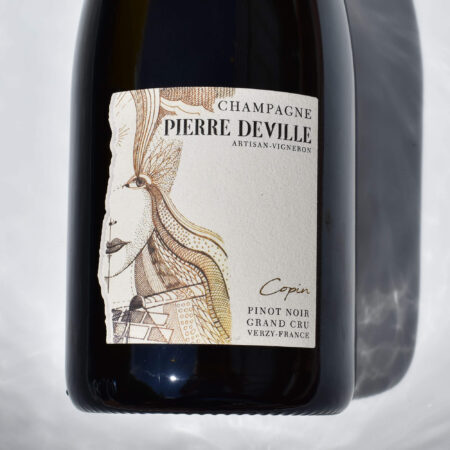
Champagne Pierre Deville · 2020 ‘Copin’ Grand Cru Blanc de Noirs
Verzy Grand Cru · 100% Pinot Noir · Extra Brut
THE APPELLATION: VERZY GRAND CRU
Most wine drinkers associate Grand Cru Champagne with the Côte des Blancs — the Chardonnay-dominated hillside south of Épernay that produces Cramant, Avize, and Le Mesnil-sur-Oger. But the Montagne de Reims, the forested plateau to the southeast of Reims, contains its own cluster of Grand Cru villages, and Verzy is one of the most singular among them. The soil here is chalk, deep, porous Belemnite limestone, but the exposures are more varied than the Côte des Blancs, and the climate carries a cooler character. Verzy is primarily Pinot Noir country: the grape finds extraordinary mineral tension here, driven by the chalk and the elevation, producing wines of unusual structure for a region famous for delicacy.
What makes Verzy particularly interesting to us is how rarely it appears as a single-village, single-parcel statement wine. Most of its fruit from the big houses goes into blends. The growers who bottle their own wine with vintage and lieu-dit on the label, are a small and serious group.
THE PRODUCER & VINEYARD
Alban Corbeaux’s great-grandfather Pierre Deville started bottling his own Champagne in 1963, at a time when most growers sold their fruit to the houses. Alban took over in 2017, the fourth generation to farm these 5 hectares of 100% Grand Cru Verzy. The ‘Copin’ Blanc de Noirs comes from a single lieu-dit — La Blanche Voie — planted in 1968 on the chalky east-facing slopes above the village. Alban farms biodynamically, harvests by hand, and ferments with indigenous yeasts. The 12-hour skin maceration before pressing is what separates this from a conventional blanc de noirs: it adds texture and a pale rose-gold tint, and it pulls more of the Pinot Noir’s character into the finished wine without tipping it into rosé territory.
Du Grappin · 2022 Vézelay Blanc
Vézelay · 100% Chardonnay
THE APPELLATION: VÉZELAY
AOC Vézelay sits in the Yonne département in the foothills below the medieval hilltop town of the same name. The soils are Kimmeridgian limestone: the same formation of compressed marine fossils and clay-limestone that gives its neighbor Chablis its renowned mineral character. The appellation was elevated to its own AOC status in 2017 (previously sold as Bourgogne Vézelay), recognition of a terroir that serious producers and sommeliers had known about for years.
What distinguishes Vézelay from Chablis, beyond the lower profile and lower prices, is a slightly warmer microclimate and more varied expositions — which means the wines tend to have a rounder mid-palate alongside the mineral drive. Andrew Nielsen describes it as ‘Chablis with a little more generosity.’
THE VINEYARD: LIEU-DIT ‘MERLUTTE’
Andrew sources fruit from the lieu-dit Merlutte, a southeast-facing parcel south of the village on classic Kimmeridgian soils. The vines are 35 years old — enough age to produce concentrated, complex fruit without the extreme low-yielding attrition of truly old vines. Andrew’s winemaking approach here is deliberately split: one-third of the wine ferments and ages in old oak foudre, which adds body and a gentle textural roundness. Two-thirds goes into concrete eggs — a vessel that preserves freshness and amplifies mineral precision without the micro-oxygenation of wood. The wine spends 12 months on full lees without any stirring, which builds complexity and texture while maintaining the wine’s characteristic salinity.
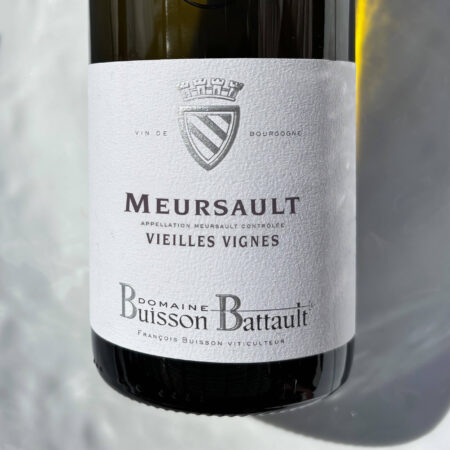
Domaine Buisson-Battault · 2022 Meursault ‘Vieilles Vignes’
Meursault Village · 100% Chardonnay
THE APPELLATION: MEURSAULT
Meursault is the largest and most commercially significant white wine village in the Côte de Beaune — and for decades it was also the most stylistically predictable. The classic traditional profile that made it famous was rich, toasty, and golden, driven by generous oak treatment and the heavy bâtonnage (lees stirring) that builds that signature creamy texture. That style still exists, but it’s increasingly the hallmark of less thoughtful producers. The best contemporary Meursault sits in a more interesting place: generous and stone-fruited, yes, but with a mineral acidity underneath that lifts the wine and gives it the tension to age.
Meursault’s clay-limestone soils are deeper than those of neighboring Puligny-Montrachet, which is why its wines tend toward more body, but the best village-level wines from the right parcels can challenge Premier Crus from other villages without difficulty. The 2022 vintage is exceptional here: a warm, dry summer produced wines of uncommon concentration, and a cooler August preserved the acidity..
THE VINEYARD & PRODUCER
François Buisson draws the Vieilles Vignes from two parcels — Les Malpoiriers and Les Pellans — with vines of 91 and 96 years of age. Vines of this age yield very small clusters of intensely concentrated fruit; they have deep root systems that draw mineral complexity from far below the surface. François presses gently, and ferments in French oak with only 20% new wood — a deliberate restraint that allows the fruit and the terroir to speak. No bâtonnage. Twelve months in oak, then six months on fine lees in tank before bottling with natural cork, unfiltered. The philosophy is patience: letting the wine find its shape.
Domaine Charlopin-Tissier · 2022 Marsannay Rouge
Marsannay Village · 100% Pinot Noir
THE APPELLATION: MARSANNAY
Marsannay is the northernmost commune of the Côte de Nuits, sitting at the top of the famous vineyards that descend through Gevrey-Chambertin, Morey-Saint-Denis, Chambolle-Musigny, and Vougeot before reaching Vosne-Romanée. Its clay-limestone mid-Jurassic soils are closely related to those of its more celebrated neighbors to the south and there is evidence of vines growing here since the 7th century.
That relative obscurity is what makes it so interesting right now. The best Marsannay producers are making wines with real Côte de Nuits character — that cool precision, the red fruit and violet aromatics, the mineral backbone — at prices that reflect village status rather than the premium that Gevrey or Vosne commands. For a wine buyer looking for serious red Burgundy that over-delivers on price, Marsannay is one of the most compelling addresses in the entire Côte d’Or.
THE PRODUCER
Yann Charlopin founded Domaine Charlopin-Tissier in 2013 with his wife Justine Tissier, taking over the old caves of Domaine David Clark in Morey-Saint-Denis. They have since moved their winery to Gevrey-Chambertin. The winemaking lineage is exceptional: Yann’s father Philippe studied directly under Henri Jayer, the winemaker widely credited with defining the modern Burgundy style — whole-cluster or fully-destemmed fermentation, cold pre-fermentation maceration, minimal intervention. Yann trained with Jean-Marie Fourrier, himself one of Gevrey’s most meticulous producers, before striking out on his own. The cold maceration technique that Jayer pioneered — chilling the grapes before fermentation to extract color and aromatics without the harsh tannins of a warm extraction — is central to how Yann makes every wine in the cellar.
Mark Haisma · 2022 Gevrey-Chambertin
Gevrey-Chambertin Village · 100% Pinot Noir
THE APPELLATION: GEVREY-CHAMBERTIN
Gevrey-Chambertin is, by many measures, the most famous red wine village in Burgundy. The village-level appellation covers a wide area, and quality varies enormously: the best parcels are on the gentle mid-slope above the village, on thin, well-drained limestone soils that produce wines of structure and aromatic complexity. The worst are on the flat ground below the Route Nationale, where heavier, more fertile soils produce dilute, over-cropped wine.
This variation is why Gevrey at the village level has a mixed reputation. The name alone commands a premium, which creates an incentive for producers to maximize yields. The wines that over-deliver at this appellation level are almost always from producers who either own parcels on better soils, manage yields aggressively, or as in Mark Haisma’s case, blend carefully from multiple sites to build complexity that no single average parcel could achieve alone.
THE VINEYARDS & PRODUCER
Mark blends from three distinct parcels: La Justice, a parcel at the northern end of the village; Croix des Champs, on mid-slope ground with lighter soils; and En Pallud, a site on the slope above the village proper. The blend gives him aromatic complexity — the lifted floral and red fruit character of the higher parcels — alongside the structural backbone of La Justice. The 50–60% whole-cluster fermentation (leaving the grape stems in the vat, a technique that adds spice and freshness) is a deliberate choice in a village-level wine: it creates complexity and texture without the need for new oak. Mark moved to Burgundy is 2007 and how has a newish winery he affectionately calls Le Shed in Gevrey-Chambertin. He spent a decade making wine at Yarra Yering in Australia under the late Dr. Bailey Carrodus — an education in restraint, precision, and letting terroir speak.
Domaine Amiot et Fils · 2021 Gevrey-Chambertin 1er Cru ‘Les Combottes’
Gevrey-Chambertin Premier Cru · 100% Pinot Noir
THE VINEYARD: LES COMBOTTES
Les Combottes vineyard sits at the boundary between Gevrey-Chambertin and Morey-Saint-Denis, and it is surrounded on three of its four sides by Grand Cru vineyards: Latricières-Chambertin to the south, Mazoyères-Chambertin to the west, and Clos de la Roche to the north. The soils are continuous with those Grand Crus: the same shallow brown limestone soils over hard rock, the same east-southeast aspect, the same elevation. In a blind tasting, a wine from Les Combottes is routinely mistaken for a Grand Cru.
In 1931, a French court drew the lines of the Grand Cru appellations in Gevrey-Chambertin and Morey-Saint-Denis. Les Combottes fell on the wrong side of one of those lines — classified as Premier Cru rather than Grand Cru. The reasons were administrative rather than geological. The practical consequence, nearly a century later, is that wine buyers can acquire a vineyard of near-Grand-Cru character at Premier Cru prices.
THE PRODUCER
The Amiot family has farmed in Morey-Saint-Denis for ten continuous generations. Jean-Louis Amiot runs the domaine today alongside his son Léon, who joined in 2020 and represents the eleventh generation. We discovered the Amiots in 2011 after trying one of their bottles recommended by the owner of a small wine shop in Gevrey-Chambertin and contacted them right away. The farming is organic, the yields are 25–35 hectoliters per hectare (low even by Burgundy standards), and the winemaking is entirely non-interventionist: no fining, no filtration, single racking just before bottling.