


Champagne has its own vocabulary. This is a reference for the terms that appear most often on labels and in producer notes — focused on what actually matters when you’re deciding what to open.
Read the full guide to grower ChampagneJump to a term
Assemblage · Autolysis · Blanc de Blancs · Blanc de Noirs · Blanc de Meunier · Brut Nature · Chef de Cave · Clos · Cuvée · Dégorgement · Dosage · Extra Brut · Grand Cru · Gyropalette · Lees · Lieu-dit · Millésime · Montagne de Reims · NM — Négociant-Manipulant · Non-Vintage · Perpetual Reserve · Premier Cru · RM — Récoltant-Manipulant · Riddling · Rosé · Saignée · Sélection Massale · Solera · Tirage · Zero Dosage
Assemblage
The blending process — assembling the final wine from multiple base wines, parcels, grape varieties, and reserve wines. In large house Champagne, assemblage is the primary tool for maintaining a consistent style across vintages. In grower Champagne, assemblage is used more selectively — often within a single domaine’s holdings rather than across purchased grapes from multiple growers. Some growers avoid assemblage entirely in favour of single-parcel, single-variety cuvées.
Autolysis
The breakdown of dead yeast cells during extended lees ageing — the process that gives Champagne its characteristic brioche, toast, and biscuit qualities. After the second fermentation in bottle, the dead yeast cells gradually break down and release complex compounds into the wine. The longer the wine ages on its lees before disgorgement, the more developed these autolytic characters become. Most grower Champagnes age on lees for significantly longer than the legal minimums — some for four years or more.
Blanc de Blancs
Champagne made exclusively from white grape varieties — almost always Chardonnay. Without the structure and body that Pinot Noir and Meunier contribute, Blanc de Blancs tends toward precision, mineral tension, and exceptional longevity. The finest examples come from chalk-dominant terroirs where Chardonnay produces fruit of concentration and acidity in equal measure. The Côte des Blancs south of Épernay is the most celebrated source, but Blanc de Blancs is made across the region — including in Grand Cru Verzy on the Montagne de Reims, where Pierre Deville makes his Copin Blanc de Blancs, and in Premier Cru Bisseuil, where Hélène Charbaut’s La Crayère comes from vines planted in 1963.
Blanc de Noirs
Champagne made from red grape varieties — Pinot Noir and/or Meunier — vinified as white wine. The juice is separated from the skins quickly after pressing to prevent colour extraction, producing a wine that is white or very pale gold despite coming from red grapes. The result is typically fuller-bodied, more structured, and more complex than a Blanc de Blancs — the red grape character comes through in weight and texture rather than colour. Antoine Bouvet’s Les Monts de la Vallée Blanc de Noirs is 100% Pinot Noir from three Premier Cru villages. Hélène Charbaut’s La Pirouette is 100% Pinot Noir from a single plot in Bisseuil planted in 1960.
Blanc de Meunier
Champagne made exclusively from Pinot Meunier — the third grape variety of Champagne, typically planted on the heavier clay soils of the western Vallée de la Marne where it ripens most readily. A Blanc de Meunier is rare — most Meunier is blended rather than vinified as a single variety. When Meunier is grown on chalk-dominant soils rather than its usual clay habitat, the results can be unusually mineral and precise. Hélène Charbaut’s La Meunière is 100% Meunier from Le Chaudion in Bisseuil — planted in 1999 on chalk-dominant clay-limestone, producing something genuinely unlike any other Meunier expression in Champagne.
Brut Nature
The driest dosage category — between 0 and 3 grams per litre of residual sugar, none of it added. Also called Zero Dosage or Non Dosé. Brut Nature is Champagne in its most unmanipulated form: the terroir, the vintage, and the winemaker’s decisions in the cellar are the only things in the glass. It requires grapes of exceptional quality and vineyards of real character to work well — without dosage to soften or balance, every imperfection in the base wine is visible. Most of the grower Champagnes on the Amitié list are Brut Nature or Extra Brut.
See also: Zero Dosage, Dosage
Chef de Cave
The cellar master — the person responsible for winemaking decisions at a Champagne house or domaine. In large houses the chef de cave is a senior position responsible for blending hundreds of reserve wines into a consistent house style across millions of bottles. In a small grower domaine the chef de cave is often the grower themselves — a single person making every decision from vineyard to bottle.
Clos
A walled or enclosed vineyard — historically associated with monastic viticulture, where Cistercian monks enclosed their finest parcels to protect them and to define their ownership. The Clos de Vougeot in Burgundy is the most famous example, but clos appear across both Burgundy and Champagne. In Champagne the term is less common than in Burgundy but appears in several notable place names including Clos du Mesnil (Krug’s famous monopole in Le Mesnil-sur-Oger) and the various Clos within Marsannay that are currently under evaluation for Premier Cru classification.
Cuvée
Used in two distinct ways in Champagne. First, as a general term for a specific wine or bottling — “the Blanc de Noirs cuvée” or “a new cuvée.” Second, and more specifically, as the term for the first and finest pressing of the grapes. In traditional Champagne production the grapes are pressed in stages — the cuvée is the first 2,050 litres from 4,000 kilograms of grapes, producing the finest, most delicate juice. The taille is the second pressing, producing coarser juice. Most serious grower Champagnes use cuvée juice only — Hélène Charbaut specifies “cuvée only — first pressing” across her entire range.
Dégorgement
Disgorgement — the step in traditional method sparkling wine production where the sediment collected in the neck of the bottle during riddling is expelled. The bottle neck is frozen, creating a plug of ice containing the sediment. The crown cap is removed, the frozen plug shoots out under pressure, and the bottle is immediately topped up with the dosage before the final cork is inserted.
The disgorgement date matters to serious buyers because it tells them how long the wine has been ageing post-disgorgement in the bottle. Two bottles of the same cuvée disgorged at different times can taste noticeably different — the more recently disgorged wine will be fresher and more primary, while an older disgorgement will have more developed, toasty complexity. All four of the Champagne producers on the Amitié list include the disgorgement date on the back label.
Dosage
The small addition of sugar — dissolved in wine and called the liqueur d’expédition — that most Champagne producers add after disgorgement to balance acidity and round out the final flavour. Measured in grams per litre. The dosage categories from driest to sweetest:
- Brut Nature / Zero Dosage — 0–3g/l, no added sugar
- Extra Brut — 0–6g/l
- Brut — 0–12g/l (the most common house style)
- Extra Sec — 12–17g/l
- Sec — 17–32g/l
- Demi-Sec — 32–50g/l
- Doux — 50g/l and above
Most serious grower Champagnes are zero dosage or extra brut — the lower the dosage the more directly the terroir and the vintage speak. A wine with high dosage can mask flaws in the base wine; a wine with no dosage has nowhere to hide.
Extra Brut
The dosage category between Brut Nature and standard Brut — between 0 and 6 grams per litre of residual sugar. Drier than the conventional Brut style most large house Champagnes use, preserving more of the wine’s natural acidity and terroir character while allowing a small amount of dosage to smooth the finish if needed. Most of the grower Champagnes on the Amitié list are Extra Brut or Brut Nature — Antoine Bouvet’s Les Monts de la Vallée range, the Adrien Renoir cuvées, and several Pierre Deville wines.
Grand Cru
The highest classification in Champagne — applied to seventeen villages whose vineyards are rated at 100% on the échelle des crus, the historic quality scale originally used to determine grape prices. Grand Cru villages are concentrated in three sub-regions: the Montagne de Reims (including Verzy, Verzenay, Mailly, Ambonnay, and Bouzy), the Côte des Blancs (including Cramant, Avize, Oger, and Le Mesnil-sur-Oger), and the Vallée de la Marne (Aÿ).
At Amitié, Champagne Pierre Deville and Adrien Renoir both farm exclusively in Grand Cru Verzy — the same village Krug sources significant fruit from, rarely named on a label.
Note: Grand Cru in Champagne means something quite different from Grand Cru in Burgundy. In Burgundy, Grand Cru refers to specific vineyard sites. In Champagne, it refers to entire villages — and the variation in quality between different parcels within a Grand Cru village can be significant.
Gyropalette
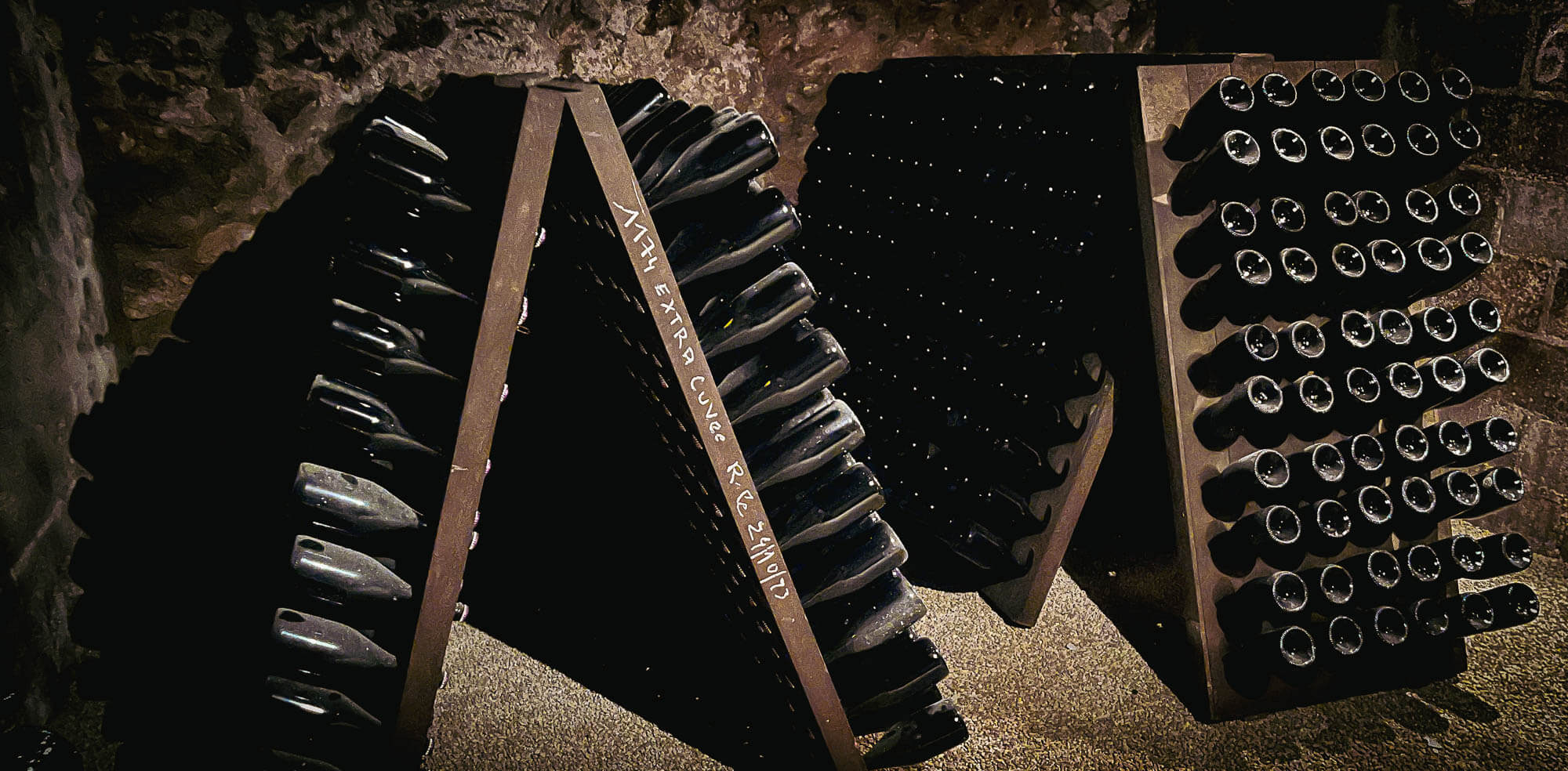
A large mechanical cage that holds hundreds of bottles and rotates them automatically to achieve the same result as manual riddling — moving the sediment from the lees ageing period toward the neck of the bottle before disgorgement. Gyropalettes complete in hours what riddling by hand takes weeks to achieve. Most large houses use gyropalettes. Most serious growers still riddle by hand — the slower process is considered gentler on the wine and more respectful of the extended lees ageing that defines the grower Champagne style.
Lees
The dead yeast cells and other particles that settle at the bottom of a vessel after fermentation. In Champagne the second fermentation takes place in the bottle itself — the lees remain in contact with the wine throughout the ageing period, contributing texture, complexity, and the characteristic autolytic qualities (brioche, toast, biscuit) of aged Champagne. Extended lees ageing is one of the defining characteristics of grower Champagne on the Amitié list. Antoine Bouvet ages some wines for four years or more on lees before disgorgement. The 2019 Saignée de Mareuil spent six years on lees.
See also: Autolysis
Lieu-dit
A named place — a specific parcel or plot within a village, identified by a traditional name that appears on cadastral maps. In Burgundy, Premier Cru and Grand Cru vineyards are always named lieu-dits. In Champagne, lieu-dit bottlings are less common but increasingly used by serious growers to identify the specific source of a wine. Antoine Bouvet’s Avenay Val d’Or Blanc de Blancs comes from a single lieu-dit — Les Plantels, planted in 1964. His Saignée de Bisseuil comes from Les Pautes, planted in 1964. Adrien Renoir farms three lieu-dits in Grand Cru Verzy: Les Montants, Les Épinettes, and Les Vignes Goisses.
Millésime
Vintage Champagne — made from a single year’s harvest rather than a blend of multiple years. Millésime Champagne is made only in years the producer considers exceptional — typically representing a small fraction of total production. Because it is not blended with reserve wines from other years, a millésime expresses the specific character of that particular harvest more directly than a non-vintage wine. Antoine Bouvet’s 2019 Saignée de Mareuil is a millésime brut from two plots planted in 1968 in Mareuil-sur-Aÿ.
Montagne de Reims
One of Champagne’s three main sub-regions — a forested plateau south of Reims whose chalk-rich slopes produce some of the finest Pinot Noir in Champagne. The Grand Cru villages here include Verzy, Verzenay, Mailly, Ambonnay, and Bouzy. The elevation and the chalk give the wines an unusual mineral tension and structure. Champagne Pierre Deville and Adrien Renoir both farm in Grand Cru Verzy on the Montagne de Reims.
NM — Négociant-Manipulant
A producer who buys grapes, must, or base wine from other growers and produces Champagne under their own label. The large Champagne houses — Moët, Veuve Clicquot, Bollinger, Krug — are all NMs. Identified on the back label by the letters NM followed by a registration number. The NM model allows for the consistent large-volume production that built Champagne’s global reputation, but the style is fundamentally different from grower Champagne — blended for consistency rather than terroir expression.
See also: RM — Récoltant-Manipulant
Non-Vintage
The most common style in Champagne — a blend of multiple harvests, typically combining the current year’s base wine with reserve wines from previous years. Non-vintage Champagne is designed for consistency across years: the house style should taste the same whether the base vintage was warm or cool, generous or lean. Most large house Champagnes are non-vintage. Some growers also make non-vintage wines — but with a fundamentally different philosophy, using perpetual reserves or soleras to add complexity rather than blending for a consistent house style.
Perpetual Reserve
A winemaking method in which a portion of wine from each harvest is added to a continuously maintained reserve that is never fully drawn off. Each year’s new wine is blended with the accumulated reserve, creating a wine that contains threads of every previous harvest going back to the beginning. The base vintage provides freshness and energy; the older reserve wines provide developed character, texture, and continuity. Hélène Charbaut’s La Charbauterie uses a perpetual reserve — 35% 2021 reserve wine maintained in both barrel and 25-hectolitre foudre. Adrien Renoir’s Les Années is built entirely on a solera — the most extended form of perpetual reserve.
See also: Solera
Premier Cru
The second-highest classification in Champagne — villages rated between 90% and 99% on the échelle des crus. There are 42 Premier Cru villages across the region. Antoine Bouvet farms across three Premier Cru villages — Mareuil-sur-Aÿ, Bisseuil, and Avenay Val d’Or — all in the Grande Vallée de la Marne. Hélène Charbaut farms in Premier Cru Mareuil-sur-Aÿ and Bisseuil.
RM — Récoltant-Manipulant
A grower who farms their own vines and makes their own wine under their own name — what is generally meant by “grower Champagne.” Identified on the back label by the letters RM followed by a registration number. The RM designation means the producer controls the entire process from vineyard to bottle — the same person who tends the vines decides how the wine is made. All four of the Champagne producers on the Amitié list are RMs: Pierre Deville, Antoine Bouvet, Hélène Charbaut, and Pascal Lejeune.
See also: NM — Négociant-Manipulant
Riddling
The process of gradually moving the sediment from lees ageing toward the neck of the bottle before disgorgement. Bottles are placed nose-down in riddling racks — called pupitres — and turned slightly each day over a period of weeks, encouraging the sediment to slide toward the neck. Once all the sediment is collected in the neck the bottle is ready for disgorgement. Manual riddling — remuage in French — is labour-intensive and increasingly rare. Most large houses use gyropalettes. Some growers still riddle by hand.
Rosé
Rosé Champagne is made in two ways. The most common method — assemblage rosé — involves adding a small amount of still red wine from the same region to the white base wine before the second fermentation. The saignée method produces rosé by bleeding juice from red grapes early in maceration — giving the wine actual skin contact, more structure, and more depth than a blended rosé. Most large house rosé Champagnes use the assemblage method. Most serious growers who make rosé use saignée.
See also: Saignée
Saignée
A method of making rosé by “bleeding” — saigner in French — a portion of juice from red grapes early in maceration, before the skins have transferred much colour. The brief skin contact gives the wine a deeper colour, more texture, and more grip than a direct-press or assemblage rosé. Saignée produces a rosé with actual tannin structure and a presence that most rosé Champagnes don’t achieve — closer to a serious rosé de gastronomie than a conventional aperitif rosé.
Antoine Bouvet uses the saignée method for several cuvées — the Les Monts de la Vallée Rosé, the Saignée de Bisseuil, and the 2019 Saignée de Mareuil.
Sélection Massale
The practice of propagating new vines from cuttings taken from the best-performing vines in an existing vineyard — as opposed to purchasing commercially produced clonal selections. The result is a population of vines that reflects the genetic diversity of the original planting — more complex, more site-adapted, and more resilient than a monoculture of a single clone. Massale selection is considered by many serious producers to be one of the most important tools for producing wines of genuine terroir character.
Adrien Renoir farms three lieu-dits of massale selection vines in Grand Cru Verzy — all planted between 1961 and 1971. Le Grappin’s Boucherottes includes a 44-year-old massale selection parcel alongside a clonal planting.
Solera
A method borrowed from Sherry production in which a portion of the oldest wine is blended with successive younger harvests, creating a continuous blend that accumulates complexity across years rather than expressing a single vintage. Unlike a perpetual reserve — where new wine is added to the reserve and a portion is drawn off each year — a true solera never fully empties: the oldest wine is always present in some proportion.
Antoine Bouvet’s Les Fleurs du Silence is a solera drawing from eight consecutive harvests — 2015 through 2022 — from Avenay Val d’Or. Adrien Renoir’s Les Années is built on a similar solera principle from Grand Cru Verzy.
See also: Perpetual Reserve
Tirage
The addition of a small amount of sugar and yeast to the base wine before bottling — triggering the second fermentation in bottle that creates the bubbles in traditional method sparkling wine. The tirage liqueur is carefully calibrated to produce the desired level of effervescence. After the second fermentation is complete the wine begins its lees ageing period — which may last anywhere from 15 months (the legal minimum for non-vintage Champagne) to four years or more for serious grower Champagnes.
Zero Dosage
Champagne made without any added sugar after disgorgement — also called Brut Nature or Non Dosé. The 0g/l on the back label refers specifically to added dosage — some wines may have a small amount of natural residual sugar from the fermentation itself, which is not the same as added dosage. Antoine Bouvet’s 2019 Saignée de Mareuil, for example, is labelled “0g/l dosage — présence de résiduel sucre” — zero added sugar, but with natural residual sugar present from the fermentation.
See also: Brut Nature, Dosage